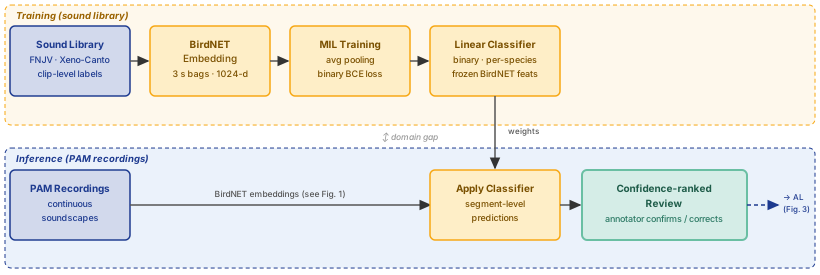
Interactive Weak Supervision for Transferring Sound Libraries to Passive Acoustic Monitoring

Passive Acoustic Monitoring (PAM) enables continuous and non-invasive biodiversity monitoring, but analysing large acoustic datasets remains difficult because sound event detectors usually require temporally precise annotations. Creating such instance-level labels is expensive and requires expert knowledge. At the same time, museum and community-run sound libraries provide large numbers of animal Read more
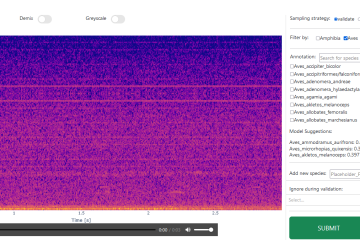
Machine Learning for Passive Acoustic Wildlife Monitoring: Methods for Semi-Automated Population and Species Assessment

Passive acoustic monitoring (PAM) has become a powerful tool for studying wildlife by continuously recording environmental soundscapes. However, analysing large acoustic datasets remains highly time-consuming, as recordings are often annotated manually by domain experts. In this work, we investigate how machine learning can support scalable biodiversity monitoring by enabling efficient Read more

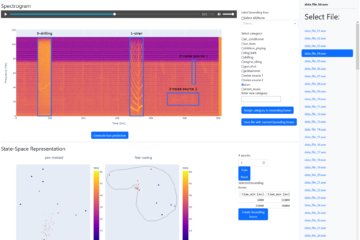
Interactive annotation of passive acoustic monitoring datasets

Passive acoustic monitoring (PAM), the recording of sounds using microphones (e.g. in biosphere reserves), is an increasingly popular method for continuous, reproducible, scalable and cost-effective monitoring of wildlife [Sugai et al., 2018]. It is widely employed in various fields, including ecology, marine biology, and conservation, to study animal behavior, biodiversity, Read more