DFKI - Interactive Machine Learning Lab

  • Home
  • Projects
    • Multimodality
    • Machine Learning
    • HCI & Virtual Reality
    • Natural Language Processing
    • Computational Sustainability
    • Lighthouse Project
  • News
  • People
  • Publications
  • Teaching
    • Courses
    • Writing a Thesis
    • Bachelor/Master Thesis at Oldenburg University
  • Jobs

Michael Barz

Multimodality

Modelling Visual Attention for Generating an Artificial Episodic Memory

Visual Attention and the Artificial Episodic Memory Recent advances in mobile eye tracking technologies opened the way to design novel attention-aware intelligent user interaction. In particular, the gaze signal can be used to create or improve artificial episodic memories for offline processing, but also real-time processing. We investigate different methods Read more
By Michael Barz, 8 yearsApril 20, 2018 ago
Hybrid Translation Workflow
Natural Language Processing

Hybrid Human-Machine Translation Services

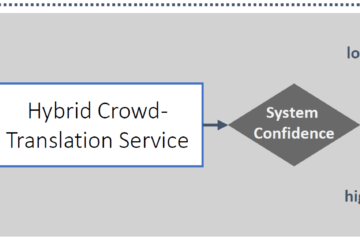
Crowdsourcing is recently used to automate complex tasks when computational systems alone fail. In this project, we investigate how humans can effectively contribute to automate natural language translation. The envisioned goal is a hybrid machine translation service that incrementally adapts machine translation models to new domains by employing human computation to Read more

By Michael Barz, 8 yearsApril 12, 2018 ago
HCI & Virtual Reality

Medical Decision Support in Virtual Reality

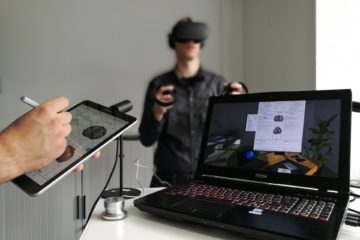
As part of the Clinical Data Intelligence project we present a speech dialogue system that facilitates medical decision support for doctors in a virtual reality (VR) application. The therapy prediction is based on a recurrent neural network model that incorporates the examination history of patients. A central supervised patient database Read more

By Alexander Prange, 8 yearsOctober 1, 2017 ago
Machine Learning

Learning through Human-Robot Dialogues

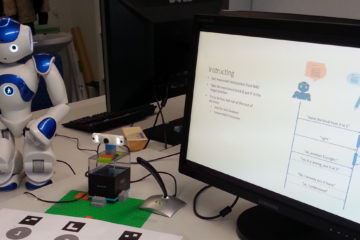
Learning through Human-Robot Dialogues Today, robots are present in our lives and they will be even more ubiquitous in the future. This advance of robotic technologies also poses the question how humans can guide the behavior of a robot and, in particular, how non-specialists can advise robots to learn new Read more

By Michael Barz, 9 yearsMarch 24, 2017 ago

Posts pagination

Previous 1 2
Search
Categories
  • Computational Sustainability (3)
  • Machine Learning (11)
  • HCI & Virtual Reality (5)
  • Multimodality (8)
  • Natural Language Processing (12)
  • Lighthouse Project (6)
Article by Year
  • 2025 (3)
  • 2024 (3)
  • 2023 (8)
  • 2022 (4)
  • 2021 (2)
  • 2020 (3)
  • 2019 (4)
  • 2018 (12)
  • 2017 (3)
  • 2016 (1)
  • 2014 (2)
Hestia | Developed by ThemeIsle