This year’s AAAI Conference on Artificial Intelligence 2026 marks another important milestone for our group, with two papers accepted to the main conference, including one selected for an oral presentation.
The AAAI conference is widely recognized as one of the premier venues in artificial intelligence, known for its competitive selection process and high scientific standards. In 2026, the conference received a record 23,680 submissions, with 4,167 papers accepted, for an acceptance rate of 17.6%. In such a highly competitive setting, having multiple contributions accepted, particularly an oral presentation, reflects the growing visibility and influence of our group’s work in the AI community.
The first accepted paper, Reinforce Trustworthiness in Multimodal Emotional Support System, was selected for an oral presentation. This work addresses a critical challenge in deploying AI systems for emotional and mental health support: ensuring trustworthiness. The paper proposes a novel framework that integrates reinforcement learning with multimodal reasoning to improve the reliability, safety, and emotional alignment of AI-driven support systems. By jointly modeling textual, visual, and contextual cues, the approach enhances the system’s ability to generate empathetic yet responsible responses, while mitigating risks such as hallucination or harmful guidance. Experimental results demonstrate significant improvements in both user trust metrics and response quality, highlighting the potential of trustworthy multimodal AI in sensitive real-world applications.
The second paper, Rethinking Progression of Memory State in Robotic Manipulation: An Object-Centric Perspective, explores a fundamental limitation in current robotic learning systems: how memory is represented and updated during sequential manipulation tasks. Instead of relying on conventional global or time-step-based memory representations, this work introduces an object-centric perspective that explicitly models the evolving states of individual objects throughout the manipulation process. This leads to more structured and interpretable memory dynamics, enabling robots to better reason about long-horizon tasks and complex object interactions. The proposed approach demonstrates improved performance across multiple robotic benchmarks, offering new insights into scalable and generalizable robot learning.
As in previous years, AAAI 2026 features a diverse and dynamic program, including keynote talks, technical sessions, workshops, and tutorials covering topics such as trustworthy AI, embodied intelligence, multimodal learning, and human-centered AI. These themes closely align with our group’s ongoing research directions. The conference also provides an excellent platform for engaging with leading researchers and institutions worldwide, fostering new collaborations and advancing interdisciplinary research efforts.
We thank our collaborators from the University of Arkansas, Carnegie Mellon University, and other partner institutions for their valuable contributions to this work.
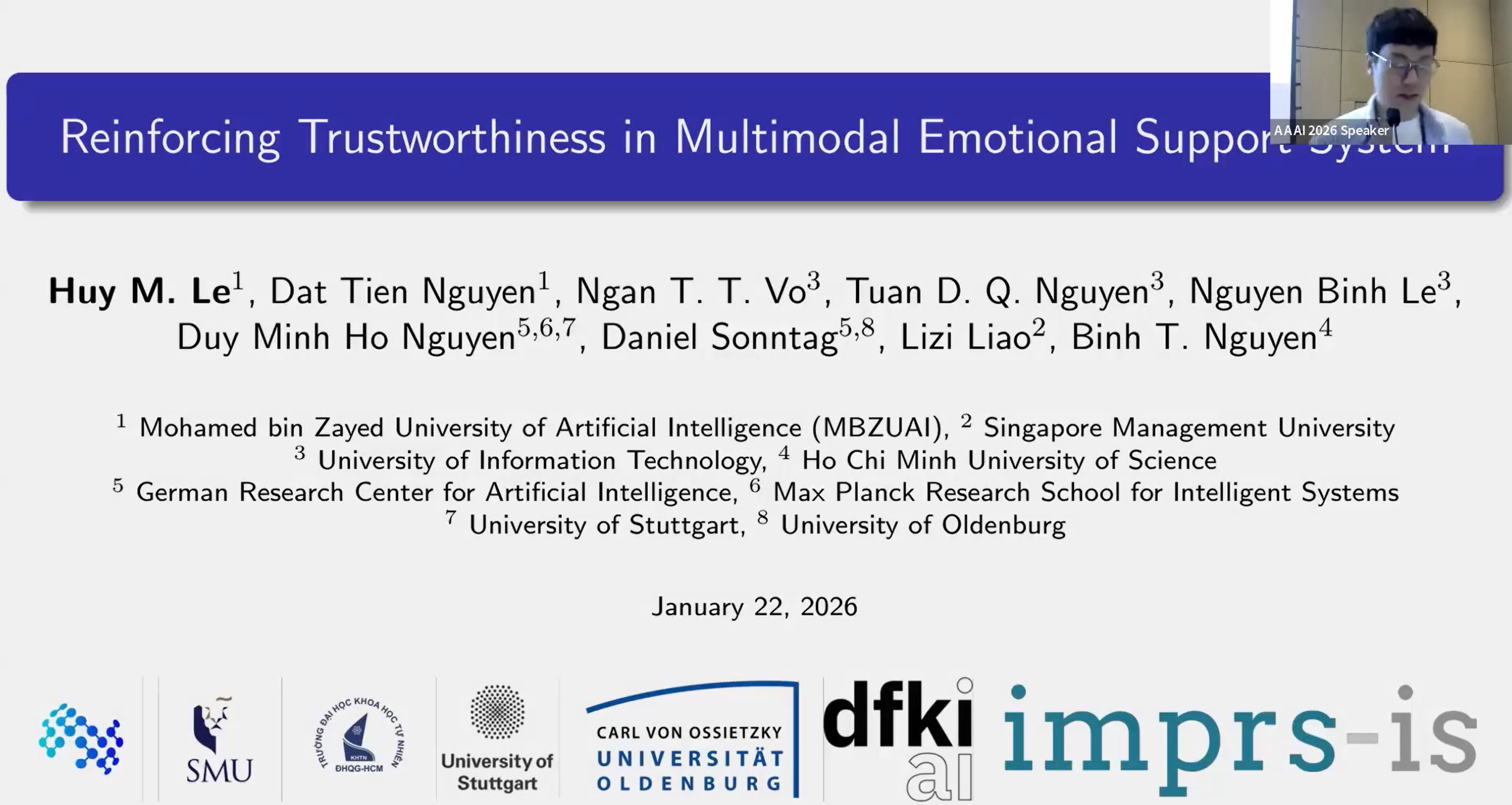
Huy Le presenting the paper “Reinforce Trustworthiness in Multimodal Emotional Support System” at the AAAI conference
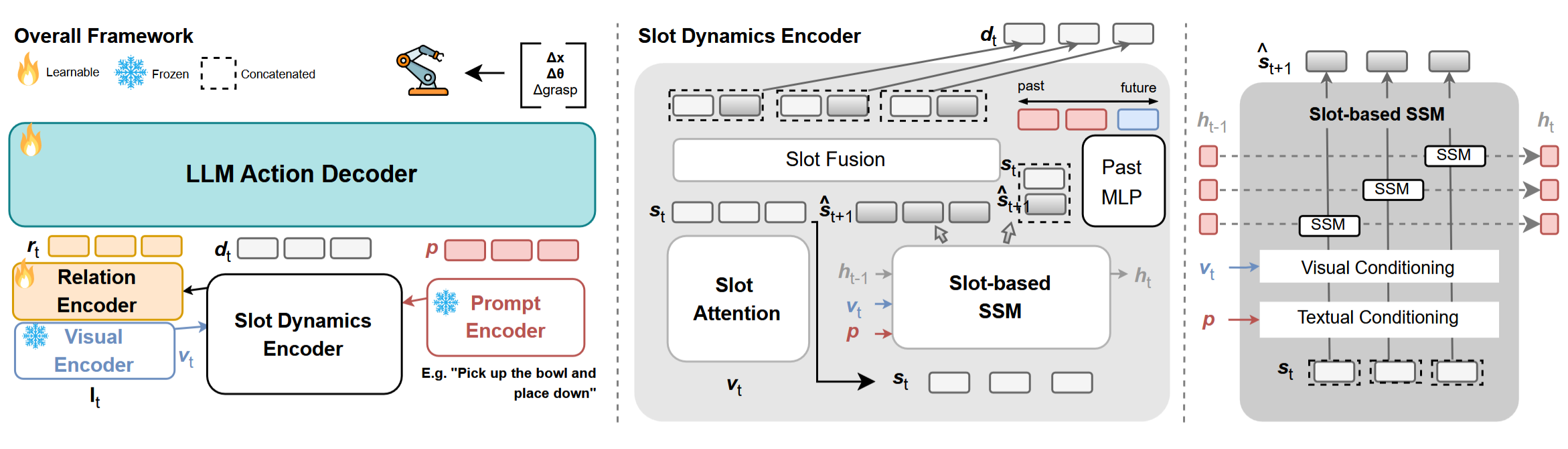
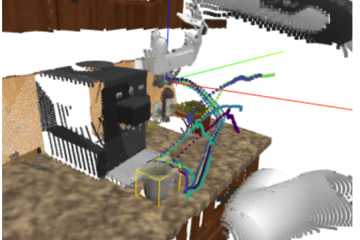
Chart showing the framework developed in “Rethinking Progression of Memory State in Robotic Manipulation: An Object-Centric Perspective”