As part of our work on AI in sports, our skiing applications aim, for example, to make skiing safer or to improve performance. They combine predictive machine learning models with multimodal sensing, such as eye tracking, wearables and drones, and deliver their assistance in augmented or virtual reality. Where experts such as mountain guides and coaches inspect and correct the system’s suggestions, we use interactive machine learning (IML), so that the models learn from these corrections. The resulting assistance is used in the field by guides, skiers and athletes.
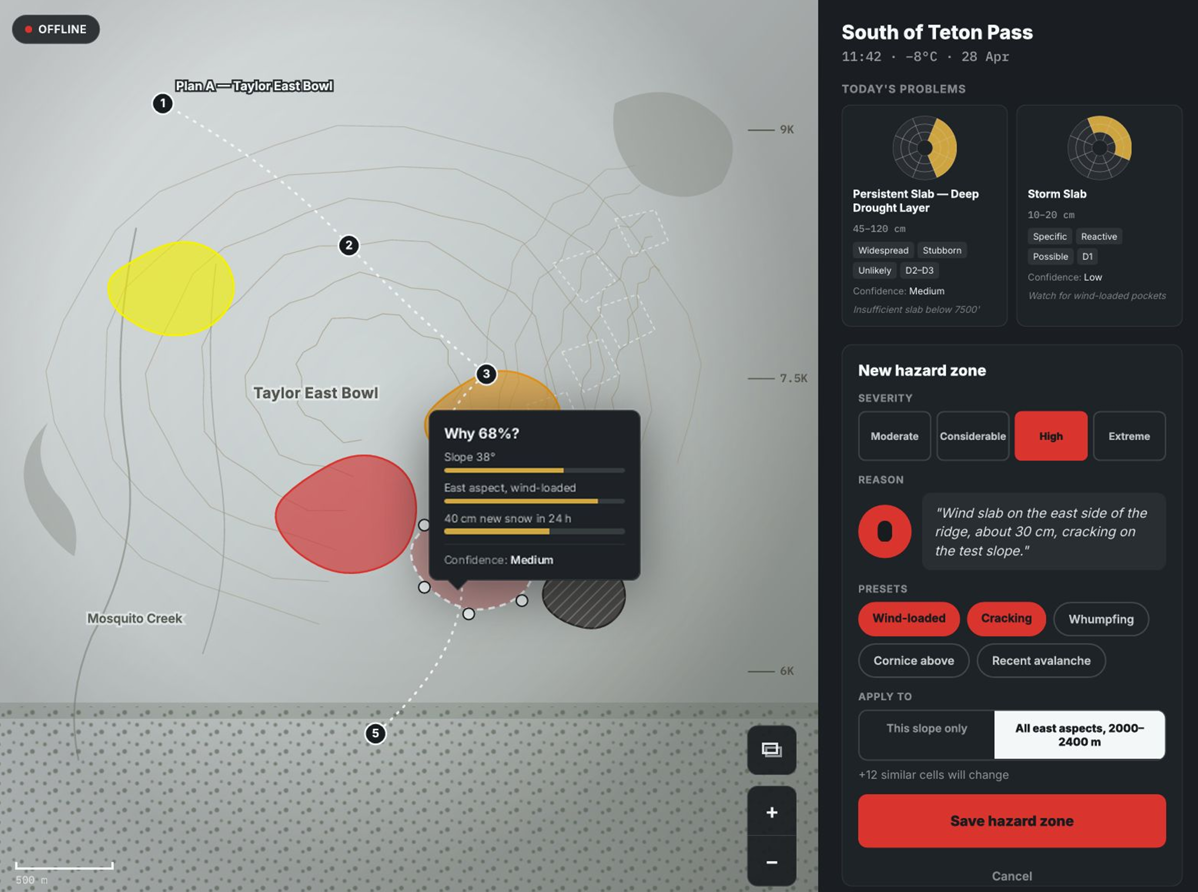
In backcountry skiing, we develop tools that support professional guides in assessing hazards as part of their daily routine, helping them revise travel plans based on forecasts and their own observations. On tour, we design tools to support safety communication between the guide and the skiers they lead. A first prototype of such a tool, combining photogrammetry annotations with AR visualisation has been presented at SportsHCI 2026 (Heads Up! teaser video).
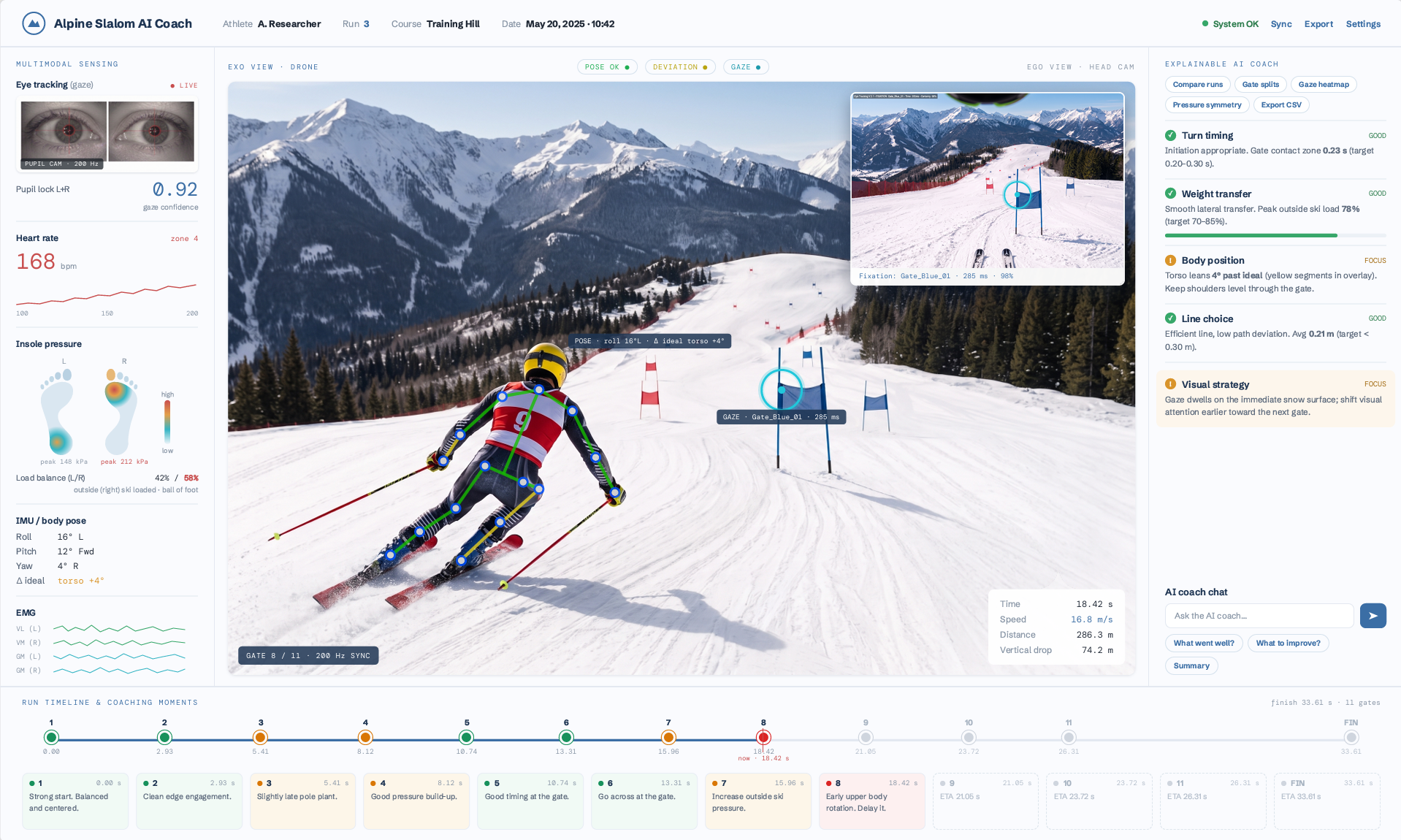
In fast-paced disciplines, such as alpine slalom skiing, how an athlete allocates their visual attention can be an important indicator of their performance. Before the race, athletes typically get a single slow pass down the course to memorise the gate layout, inspect the terrain and snow conditions, and to plan their moves. We study how athletes allocate their visual attention during this inspection and during the race, with the aim of providing adaptive visual guidance to athletes and personalised coaching that coaches can inspect and adjust. We collaborate with the Institute of Science Tokyo, Japan, to build a prototype in a VR simulator, and we plan to transfer it to real-world training conditions afterwards.
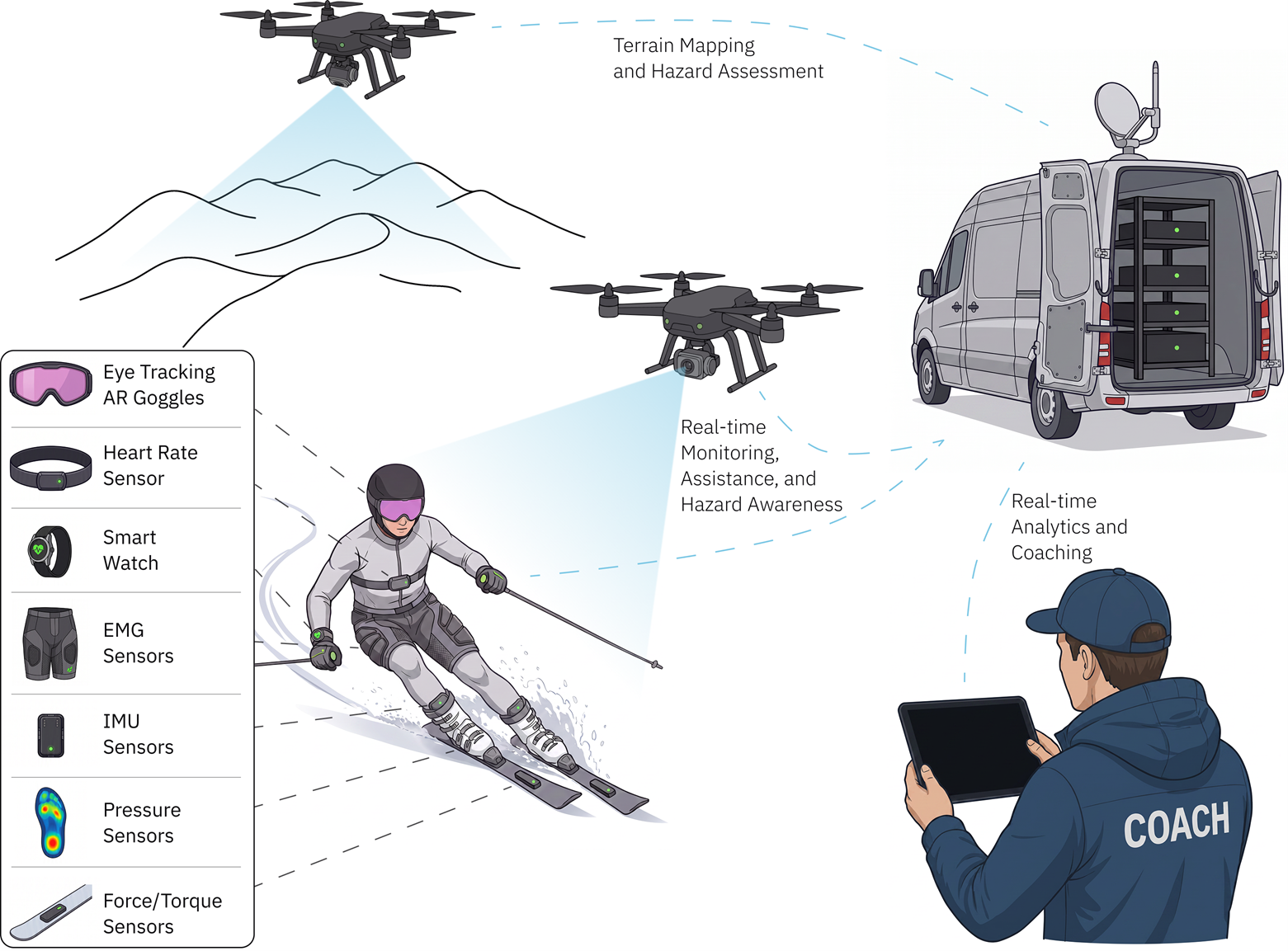
Both lines of work require a similar set-up, which we are working towards. Sensors, such as eye trackers and smartwatches, worn by the skier are combined with drones that map and analyse the mountainside and follow the skier during the descent. Because network coverage on the mountain is often unreliable, the data are processed on site, so that the guide or the athlete receives assistance in real time and can respond to it.
Contact: László Kopácsi
Relevant IML publications:
Christoph Albert Johns, László Kopácsi, and Daniel Sonntag. 2026. Why Sports Needs Interactive Machine Learning. In International Conference for Human-Computer Interaction and Sports (SportsHCI 2026), November 16–18, 2026, Saarbrücken, Germany. ACM, New York, NY, USA, 10 pages. https://doi.org/10.1145/3838843.3838849
Christoph Albert Johns, László Kopácsi, Michael Barz, and Daniel Sonntag. 2026. Heads Up!: Towards In Situ Photogrammetry Annotations and Augmented Reality Visualizations for Guided Backcountry Skiing. In International Conference for Human-Computer Interaction and Sports Companion (SportsHCI Companion 2026), November 16–18, 2026, Saarbrücken, Germany. ACM, New York, NY, USA, 8 pages. https://doi.org/10.1145/3801727.3844937
Teaser video: https://youtu.be/iPbC_feqj_8
Abdulrahman Mohamed Selim, László Kopácsi, Christoph A. Johns, and Daniel Sonntag. 2026. Understanding and Designing a Gaze-Based Interface for Table Tennis. In International Conference for Human-Computer Interaction and Sports Companion (SportsHCI Companion 2026), November 16–18, 2026, Saarbrücken, Germany. ACM, New York, NY, USA, 6 pages. https://doi.org/10.1145/3801727.3844923
Sponsored by




2024-2027