Skiing is a multi-faceted, skill-based sport practised by millions of recreationalists and professionals, and it provides uniquely challenging conditions for AI research. It is commonly practised in remote and hazardous outdoor environments, it is deeply social, and it involves complex bodily or even interpersonal coordination at high speeds.
To support skiers, we develop AI systems that are explainable, interpretable, trustworthy, and reliable, and we aim to bring them into use outside the laboratory. Skiing tests these properties under hard conditions. A guide who decides whether a slope is safe must see what a hazard estimate rests on and be able to correct it with their own observations. An athlete can act only on coaching that they understand and matches their skill level. We therefore follow the interactive machine learning (IML) approach: the guide or the athlete stays in the loop, the system explains its suggestions, which skiers can act on, and the system learns from their feedback.
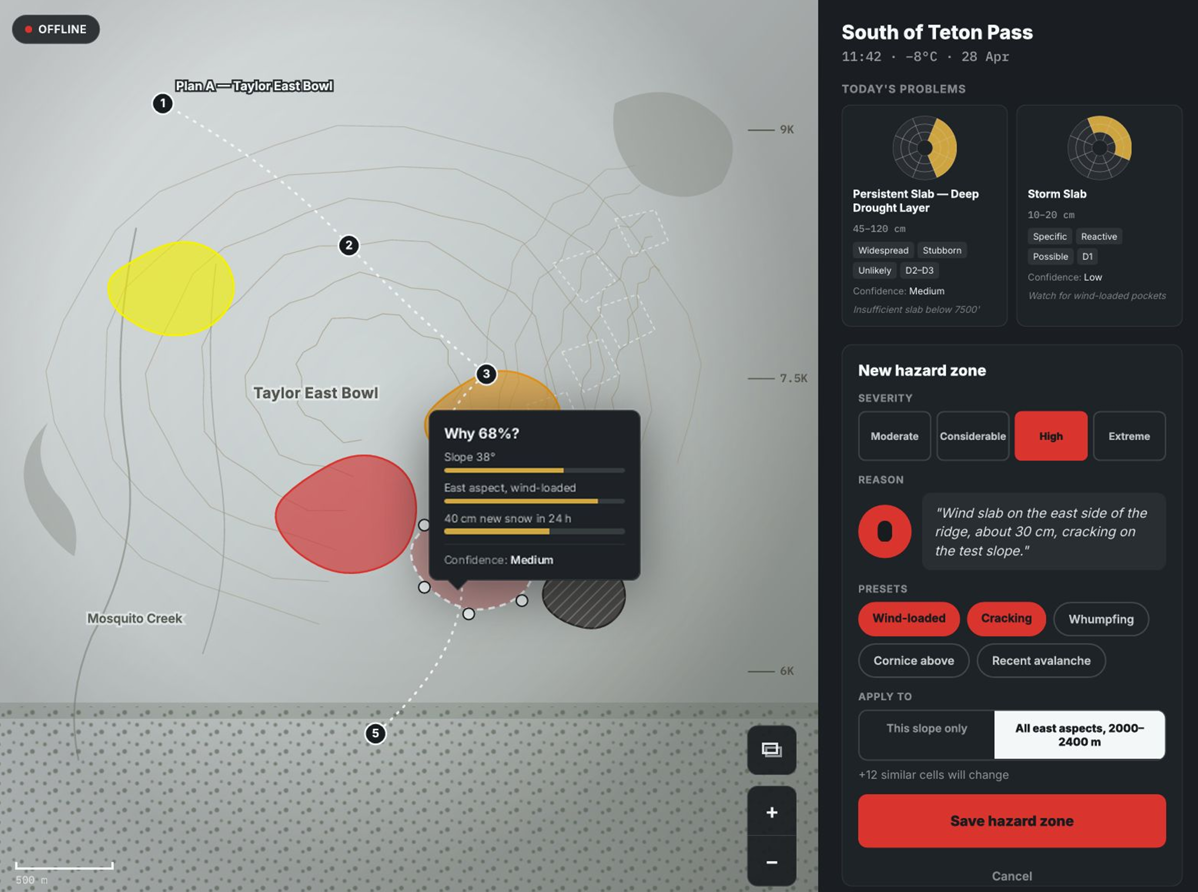
In off-piste skiing, such as in backcountry skiing, our aim is to prevent harm to skiers. We develop tools that support professional guides in assessing hazards as part of their daily routine, helping them revise travel plans based on forecasts and their own observations. For the field, we design tools to support safety communication between the guide and the skiers they lead, as demonstrated in the Heads Up! teaser video.
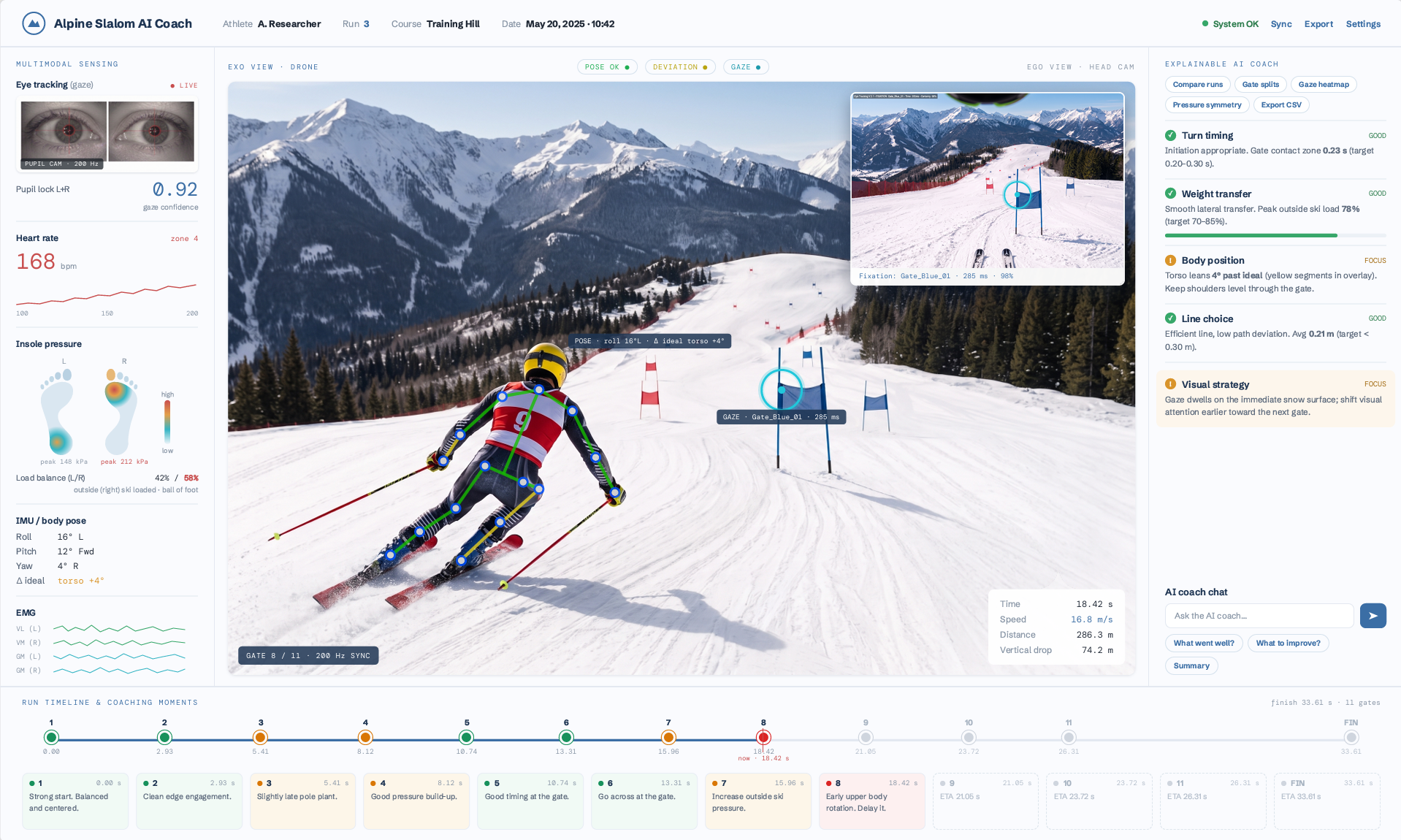
In fast-paced disciplines, such as alpine slalom skiing, how an athlete allocates their visual attention is an important indicator of their performance. Before the race, athletes typically get a single slow pass down the course to memorise the gate layout, inspect the terrain and snow conditions, and to plan their moves. We study how athletes allocate their visual attention during this inspection and during the race, with the aim of providing adaptive visual guidance and personalised coaching. We collaborate with the Institute of Science Tokyo, Japan, to build a prototype in a VR simulator, and we plan to transfer it to real-world training conditions afterwards.
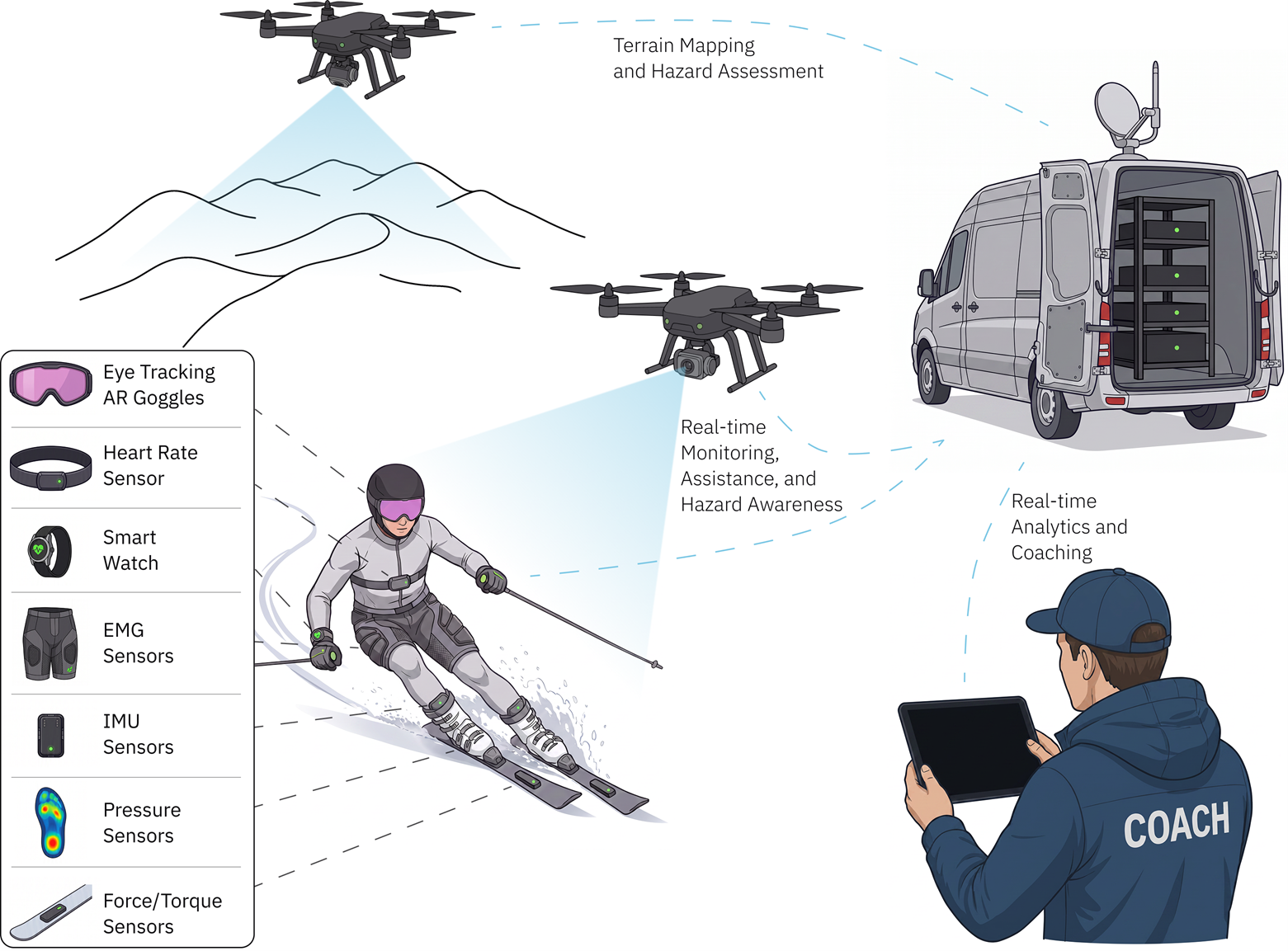
Both lines of work require a similar set-up, which we are working towards. Sensors, such as eye trackers and smartwatches, worn by the skier are combined with drones that map and analyse the mountainside and follow the skier during the descent. Because network coverage on the mountain is often unreliable, the data are processed on site, so that the guide or the athlete receives assistance in real time and can respond to it.
Relevant IML publications:
Christoph Albert Johns, László Kopácsi, and Daniel Sonntag. 2026. Why Sports Needs Interactive Machine Learning. In International Conference for Human-Computer Interaction and Sports (SportsHCI 2026), November 16–18, 2026, Saarbrücken, Germany. ACM, New York, NY, USA, 10 pages. https://doi.org/10.1145/3838843.3838849
Christoph Albert Johns, László Kopácsi, Michael Barz, and Daniel Sonntag. 2026. Heads Up!: Towards In Situ Photogrammetry Annotations and Augmented Reality Visualizations for Guided Backcountry Skiing. In International Conference for Human-Computer Interaction and Sports Companion (SportsHCI Companion 2026), November 16–18, 2026, Saarbrücken, Germany. ACM, New York, NY, USA, 8 pages. https://doi.org/10.1145/3801727.3844937
Teaser video: https://youtu.be/iPbC_feqj_8
Abdulrahman Mohamed Selim, László Kopácsi, Christoph A. Johns, and Daniel Sonntag. 2026. Understanding and Designing a Gaze-Based Interface for Table Tennis. In International Conference for Human-Computer Interaction and Sports Companion (SportsHCI Companion 2026), November 16–18, 2026, Saarbrücken, Germany. ACM, New York, NY, USA, 6 pages. https://doi.org/10.1145/3801727.3844923
Sponsored by


2024-2027